Debtor control is the routine that gets customers to pay on the date you agreed. It covers the terms you set before the work starts, the invoice, a chase sequence with fixed dates, the measures you watch, and the late payment interest and compensation the law lets you charge another business. Every day you take off the time customers take to pay puts a day's sales back in the bank.
The routine works best when it is the same for every customer and runs every week. It needs a named person to own it, a written sequence, and an owner who backs that person when a large customer is slow.
Debtor days and the cash they hold
Debtor days measures how long customers take to pay. Divide the amount customers owe you by your sales for the year, and multiply by 365. Use sales including VAT if your debtors figure includes VAT, so the two are on the same basis. The debtor days calculator does the sum.
Cash released by bringing debtor days from 60 to 45
| Sales for the year, including VAT | £1,800,000 |
| Sales for one day (£1,800,000 ÷ 365) | £4,932 |
| Owed by customers at 60 days | £295,890 |
| Owed by customers at 45 days | £221,918 |
| Cash released | £73,973 |
An example on invented figures.
That £73,973 comes in once, and stays in the bank for as long as debtor days stay at 45. It reduces what the business needs to borrow. Work out your debtor days at every month end and show it in the monthly KPI pack.
1. Set the terms before the work starts
Customers pay to the terms they agreed, so agree them in writing before the first job.
- Set a payment term, for example 30 days from the date of invoice, and print it on the quote, the order acknowledgement and every invoice.
- Check a new business customer before giving credit: its filed accounts and filing history at Companies House, and a credit report for larger amounts.
- Set a credit limit for each customer and review it when they ask for more work.
- Take a deposit or stage payments on large jobs, so the customer pays for materials and labour as you incur them.
- Name the person who approves invoices at the customer, and the details their accounts team needs, such as a purchase order number.
- State your late payment terms, including statutory interest and compensation.
The law sets limits on the terms. GOV.UK says payment periods agreed between businesses should usually be no longer than 60 days, and longer periods must be fair to both businesses. For public authorities the usual limit is 30 days.
2. Invoice on the day
The payment clock starts when the customer receives the invoice. An invoice sent a week after the work is done adds a week to your debtor days before the customer has done anything wrong.
- Invoice the day the job is finished or the goods are delivered. Move from a weekly invoicing run to a daily one.
- Make every invoice payable first time: the right customer entity, the purchase order number, the contact who approves it, a clear description and proof of delivery where the customer asks for it.
- Send it to the accounts payable address as well as your contact on site.
- Add a payment link for card or bank payment. Xero and other accounts software can add one to each invoice.
- Offer Direct Debit to customers who buy every month.
3. Run the chase sequence
Every overdue invoice goes through the same steps on the same days. Use the due date as day 0.
| Day | Action | Who |
|---|---|---|
| −5 | Email a reminder with a copy of the invoice and the due date | Credit controller |
| +1 | Phone the customer's accounts team. Confirm they have the invoice and get a payment date | Credit controller |
| +7 | Second call. Email a statement of every open invoice | Credit controller |
| +14 | Letter or email setting out the statutory interest building up each day and the fixed compensation | Credit controller |
| +21 | The owner or a director phones a director at the customer. New orders go on hold | Owner |
| +30 | Final demand giving 7 days to pay before the debt is passed for recovery | Owner |
| +37 | Interest and compensation invoice sent. Debt passed to a recovery firm or solicitor | Owner |
Record every call: the date, who you spoke to, what they said and the date they promised. When a promised date passes, the next call is the same day. If a customer gives a reason for not paying, resolve it within five working days, and ask for the undisputed part of the invoice to be paid now.
Put the stop on new orders in your terms and use it. A stop on new orders gives the customer's accounts team a reason to pay you first.
4. Charge statutory interest and compensation
The Late Payment of Commercial Debts (Interest) Act 1998 lets a business charge another business interest on a late payment, plus a fixed sum towards the cost of recovering it. It does not cover sales to consumers.
A payment is late when it passes the date you agreed. If no date was agreed, GOV.UK says it is late 30 days after the customer receives the invoice or you deliver the goods or service, whichever is later.
Statutory interest is 8% a year plus the Bank of England base rate. The base rate used is fixed for six months at a time (SI 2002/1675, article 4):
- Interest that starts to run between 1 January and 30 June uses the base rate in force on the previous 31 December.
- Interest that starts to run between 1 July and 31 December uses the base rate in force on 30 June.
The base rate was 3.75% on 30 June 2026, so statutory interest on a debt that became late between 1 July and 31 December 2026 is 11.75% a year. The Bank of England raised the base rate to 4% on 5 November 2026. Debts that become late from 1 January 2027 will use the rate in force on 31 December 2026. Once set, the rate stays the same for the life of that debt.
You cannot claim statutory interest if your contract sets a different rate of interest. With a public authority, you cannot agree a lower rate.
| Amount of the debt | Fixed compensation |
|---|---|
| Up to £999.99 | £40 |
| £1,000 to £9,999.99 | £70 |
| £10,000 or more | £100 |
The fixed sum is charged once for each late payment. GOV.UK says you can also claim reasonable costs each time you try to recover the debt. To claim, send the customer a new invoice for the interest and compensation.
To work out the interest, multiply the amount owed by the annual rate, divide by 365 for the daily figure, and multiply by the number of days late.
Interest and compensation on an invoice paid 45 days late
| Invoice due 15 September 2026, interest runs from 16 September | £8,400.00 |
| Statutory rate: 8% plus the 3.75% base rate on 30 June 2026 | 11.75% |
| Interest for a year (£8,400 × 11.75%) | £987.00 |
| Interest for one day (£987 ÷ 365) | £2.70 |
| Interest for 45 days | £121.68 |
| Fixed compensation for a debt of £1,000 to £9,999.99 | £70.00 |
| Total to claim | £191.68 |
An example on invented figures.
The guide to charging interest on late payments has wording for your terms of business and your invoices.
Setting credit limits
A credit limit is the most a customer can owe you at any one time. Set it from the customer's expected monthly spend and your payment terms, with a margin for timing. A simple rule: monthly spend multiplied by the number of months between delivery and payment, plus half a month.
Credit limit for a customer buying £20,000 a month on 30-day terms
| Expected monthly spend | £20,000 |
| Months from delivery to payment on 30-day terms, plus half a month | 1.5 |
| Credit limit | £30,000 |
An example on invented figures.
Check the limit before each new order. When an order would take the customer over it, ask for payment of the oldest invoices first or a deposit on the new order. Review limits every six months against the customer's latest filed accounts and how they have paid you.
Getting paid by large customers
Large companies and public bodies pay through an accounts payable team that runs to its own rules. Learn them at the start.
- Complete the supplier set-up form before the first invoice, with your bank details on headed paper.
- Ask for the payment run dates. If the customer pays on the last Thursday of the month, an invoice approved a day late waits a month.
- Get a purchase order number for every job, and put it on the invoice.
- Use their supplier portal if they have one, and check each invoice shows as approved.
- Know who approves each invoice on the customer's side, and ask them to approve it in the week it arrives.
The Reporting on Payment Practices and Performance Regulations 2017 require qualifying large companies to publish a report for each reporting period on how they pay suppliers, on a government service. The reports can be searched at check-payment-practices.service.gov.uk. Read your largest customers' reports before you agree terms.
When a customer cannot pay
Watch for the signs: a second broken promise, part payments with no explanation, a request for longer terms, a change of directors, or accounts filed late at Companies House. When you see two of them, act that week.
- Stop new orders until the account is back within terms.
- Agree a payment plan in writing, with dates and amounts, and the interest you will waive if every payment arrives on time.
- Ask for security for any further work: payment in advance, a personal guarantee or a parent company guarantee.
- Pass the debt for recovery once a plan is broken.
- Take advice from an insolvency practitioner or solicitor if the customer enters administration or liquidation, and send your claim to the office-holder.
5. Hold a weekly debtor meeting
Hold the meeting every week at the same time, for twenty minutes, with the credit controller and the owner or finance director. Work from the aged debtors report.
- The ten largest overdue balances: the promised date, the last contact and the next action for each.
- Every invoice over 30 days overdue: the next step in the sequence and who takes it.
- Disputes: what is needed to resolve each one and by when.
- Customers on stop, and any request to take one off.
- New customers and credit limits to approve.
- Changes to the receipts line in the 13-week cash flow forecast.
Measures to watch each month
- Debtor days, against your payment terms and last month.
- The share of debtors overdue, and the share more than 60 days overdue.
- The ten largest balances as a share of all debtors. A high share means one late payer can leave a hole in the bank.
- Disputed invoices, by number and value.
- Days from job completion to invoice. The aim is zero.
Mistakes owners make with debtors
- Invoicing in a batch at the end of the week or month.
- Chasing by email only. A phone call gets a named person and a date.
- Letting the salesperson decide whether a good customer is chased.
- Taking new orders from a customer who is already well past terms.
- Leaving disputes unresolved, so the undisputed part of the invoice goes unpaid too.
- Giving credit without checking the customer's filed accounts.
- Never charging interest, so customers learn your terms have no consequence. You can waive interest on one invoice and keep the right for the next.
What good looks like
- Debtor days within five days of your payment terms.
- Every invoice sent on the day the work is finished.
- A named person who owns credit control and a written sequence they follow.
- A weekly debtor meeting with the owner present.
- Late payment terms on every quote and invoice, and interest charged when the sequence reaches day 37.
- Credit checks and limits for every new account.
How Buzz runs credit control
The Buzz Financial Controller service invoices your customers on the day, chases them every week, prepares the interest invoices you decide to send and runs the supplier payments, for £1,500 + VAT a month, with a monthly board pack. The credit control page sets out the weekly routine. The Finance Manager service, from £750 + VAT a month, keeps the sales ledger in Xero up to date so the aged debtors report is right every Monday. The guide on how to reduce debtor days and the break-even calculator show what faster payment and better prices do for cash and profit.
Sources: GOV.UK, Late commercial payments: charging interest and debt recovery (when a payment is late, payment periods); GOV.UK, Charging interest on commercial debt (8% plus base rate, the contract rate, the method, a new invoice); GOV.UK, Claim debt recovery costs (the fixed sums, once per payment, reasonable costs); legislation.gov.uk, SI 2002/1675, article 4 (the reference dates); Bank of England, Bank Rate history (3.75% from 18 December 2025, 4% from 5 November 2026); legislation.gov.uk, SI 2017/395, regulation 3, and GOV.UK, Business payment practices and performance reporting requirements. Each checked on 19 November 2026.
Questions
How do I work out debtor days?
Divide the amount your customers owe you at the month end by your sales for the last 12 months, and multiply by 365. If customers owe £200,000 and sales for the year are £1,460,000, debtor days are 50. Use the same basis for both figures: if the debtors balance includes VAT, as it does in Xero, use sales including VAT. A business with seasonal sales can use the last three months of sales multiplied by four, so the figure reflects current trading. Compare the result with your payment terms. A business on 30-day terms with debtor days of 50 has customers paying, on average, 20 days late.
What is the statutory interest rate on late payments now?
Statutory interest is 8% a year plus the Bank of England base rate in force on a fixed reference date. For a debt that became late between 1 July and 31 December 2026, the reference date is 30 June 2026, when the base rate was 3.75%, so the rate is 11.75% a year. For a debt that becomes late between 1 January and 30 June 2027, the reference date is 31 December 2026. The Bank of England raised the base rate to 4% on 5 November 2026, and its next decision is due on 17 December 2026. The rate set for a debt stays the same until it is paid.
Can I charge late payment interest to a consumer?
No. The Late Payment of Commercial Debts (Interest) Act 1998 covers money owed by one business to another, and money owed to a business by a public authority. Sales to consumers are outside it, so statutory interest and the fixed compensation sums cannot be claimed from a private individual. A business selling to consumers can include its own interest charge in its terms, as long as the terms are fair under consumer law, and can ask for payment in advance or on the day. For consumer work, deposits, stage payments and card payment at the time of sale do more to protect cash than any interest clause.
When should I stop supplying a customer who pays late?
Put the point in your terms of business and apply it to every customer: for example, new orders go on hold when any invoice is 21 days overdue, and restart when the account is back within terms. Tell the customer at the second call and again in writing before it happens. The decision sits with the owner, who weighs the size of the account against the cash at risk. Stopping supply on a set day gives their accounts team a reason to pay you ahead of suppliers who keep delivering.
Does outsourced credit control pay for itself?
It pays for itself when the cash it releases, and the time it frees, cost more than the fee. Take a business with £1.8m of sales and debtor days of 60. Bringing them to 45 releases about £74,000 of cash. The Buzz Financial Controller service, at £1,500 + VAT a month, invoices on the day, chases every week, prepares interest invoices and runs supplier payments, alongside a monthly board pack. Compare that with the time you or your staff spend chasing today, and with the interest on the overdraft the late payments force you to use.
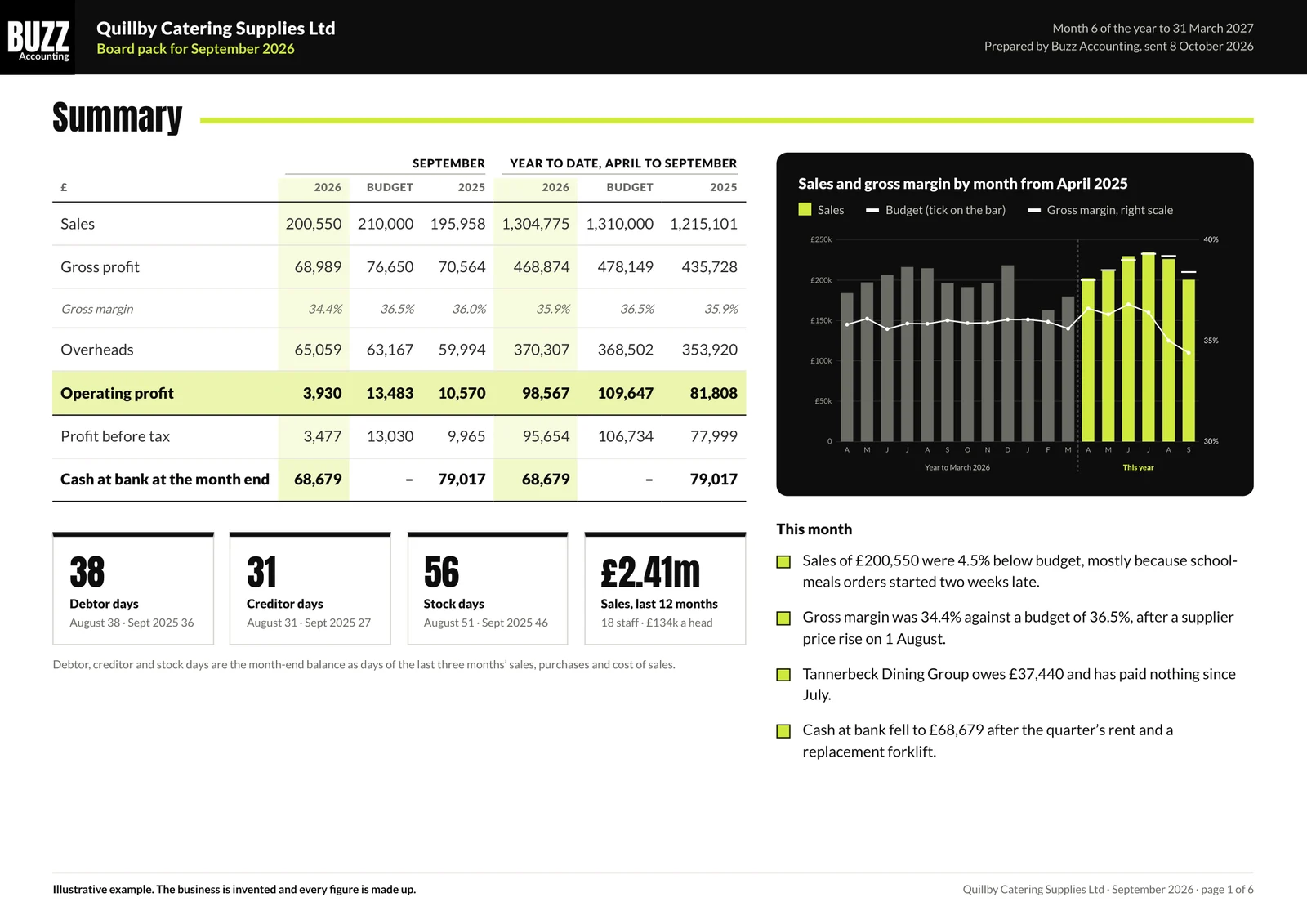
Sample monthly board pack
Six pages for one month at an invented catering wholesaler with 18 staff, prepared the way the finance team prepares one for a client.
- 1Summary
- 2Profit and loss
- 3Balance sheet
- 4Cash
- 5Customers and suppliers
- 6Commentary
More guides

The 13-week cash flow forecast
How to build a 13-week cash flow forecast, update it every Monday and act on it, with payroll, PAYE, VAT and Corporation Tax in the right weeks.

Month-end close for a small business
How to close the books by working day 10: the reconciliations, accruals and prepayments, the review, and what the management accounts should show.

The monthly KPI pack and board pack
The 8 to 12 numbers an owner-managed business should see every month, how to read them, and what a monthly board pack contains, with a worked example.

13-week cash flow forecast template
A free Excel template for the next 13 weeks of receipts, payments and bank balance.
Sample board pack
A six-page monthly board pack to download.

Cash flow forecasting
How to build a 12-month forecast and keep it up to date.

How to read a cash flow forecast
What each line means and where a tight month shows up.

Why a profitable business runs out of cash
Profit is counted when you invoice and cash moves when you are paid. Where the difference goes, how much cash you need, and ways to release it.

How to reduce debtor days
How to work out debtor days, the steps that bring them down, from payment terms to a weekly chasing routine, and the cash a lower figure releases.

Charging interest on late payments
Statutory interest at 8% above base rate, the fixed sums of £40, £70 and £100, when the late payment law applies, how to claim and how to word your terms.

Setting aside money for VAT, PAYE and Corporation Tax
When VAT, PAYE and Corporation Tax are due, how to work out what to move to a tax account each month, and a worked example for a limited company.

CIS deductions and a builder's cash flow
How CIS deductions of 20%, 30% or nothing reduce what a subcontractor banks on each invoice, HMRC deadlines, and gross payment status.

Outsourced credit control and how it works
What an outsourced credit controller does each week, how it runs in your Xero, what it costs against employing one, and the cash it releases.

Cash flow forecasting in Xero
What Xero's short-term cash flow projection shows, what it leaves out, and how to keep a 13-week or 12-month forecast alongside Xero.
Management accounts explained
The contents of a monthly management pack, and how to read it.

KPIs to check every month in a small business
The KPIs an owner-managed business checks each month, how to set targets, leading and lagging measures, and a worked monthly KPI sheet.

Gross margin explained
What gross margin is, how it differs from mark-up, how to calculate it, what moves it and why to check it monthly, with a worked example of the confusion.

Working capital explained
What working capital is, how to calculate it from a balance sheet, the working capital cycle in days, why growth uses cash, and a worked example.

Budget against actual variances explained
How to compare each month's results with the budget, tell favourable from adverse variances, split price from volume and decide which ones to act on.

What management accounts cost and include
Management accounts from £375 a month quarterly or £499 monthly + VAT: what a monthly set contains, what the owner provides and when it should arrive.

Management accounts for a construction company
Management accounts for builders and contractors: work in progress, retentions, CIS deductions, the VAT reverse charge and margin by contract.
Setting up monthly management reports in Xero
How to set up monthly management reports in Xero: the ledger work first, then the Management Report pack, budget variance, tracking and commentary.

How to price for profit
What a price change does to profit, worked through.

Turnover up, profit down
Why sales can rise while profit falls, and where to look.

How to set an annual budget for your business
Six steps to next year's budget, a month-by-month worked example, seasonality, wage rises from April 2026, and reforecasting during the year.
Break-even point explained
How to work out break-even in sales and in units from fixed costs, variable costs and contribution margin, with a worked example and the margin of safety.

What a price rise does to profit
How a small price rise flows straight to profit, how many customers you could lose and still be better off, and how much more you must sell after a discount.
Job costing for small businesses
How to cost each job with materials, labour at a loaded hourly rate, subcontractors and overheads, compare quoted with actual, and value work in progress.

What does a part-time finance director do?
What a part-time or fractional finance director does, the first three months, how it differs from a financial controller, and what one costs.

Finance manager or financial controller?
What a finance manager does, what a financial controller adds, the month-end close, deadlines, how to choose, and what each costs to employ or outsource.
Month-end close checklist
The steps to close the books within five working days: bank, ledgers, accruals, prepayments, payroll, VAT, stock, fixed assets and a final review.

In-house or outsourced bookkeeper?
What employing a bookkeeper costs once National Insurance, pension and holiday cover are added, what an outsourced service covers, and how to switch.

How to run a monthly board meeting
Who attends a board meeting in an owner-managed company, what goes in the board pack, a standard agenda, the decisions and actions log, and the minutes.

Replacing a bookkeeper who has left
Keeping payroll, VAT and the books running when your bookkeeper goes.
The cost of employing a financial controller
What a finance manager, financial controller and finance director cost to employ in 2026 to 2027, with National Insurance and pension, against Buzz fees.
How much a part-time finance director costs
A part-time finance director from Buzz costs £2,000 + VAT a month with the finance team included, against £128,508.40 a year to employ one.
Fractional CFO, part-time FD or interim FD
What a fractional CFO, a part-time finance director, an outsourced CFO and an interim FD each are, and how to choose one for your business.

What a bank wants to see in a business plan
What a lender reads in a business plan: the amount and purpose, ability to repay, forecasts, assumptions, security, guarantees and the people running it.
Bank loan covenants explained
The financial covenants in a bank loan, how interest cover, debt service cover and net debt to EBITDA are worked out, and how to see a breach coming.

Cash flow forecast for a lender
The forecast a bank or lender asks for, and what they check in it.
Preparing your business for financial due diligence
What a buyer's or investor's financial due diligence asks for, how normalised profit and add-backs work, and how long before a sale to start preparing.
Talk to us
Tell us about the business and what is taking up your week, or book 30 minutes with Peter. He will come back within 48 hours with the level that fits and a fixed monthly fee.
Book a callOr call
07476 989568Accreditations and partners