Management accounts from Buzz cost from £375 a month for a quarterly set and £499 a month for a monthly set, plus VAT, as part of Business Pulse and charged on top of the accounts fee. A monthly set contains a profit and loss account against budget, a balance sheet, a cash flow statement, aged debtors and creditors, KPIs, written commentary and the amount the business owes HMRC.
Business Pulse starts with an annual budget and a rolling 12-month cash flow forecast. Each month or quarter, the actual figures are set against that budget with written commentary, and a review meeting ends in agreed actions for the next period. Management accounts explained goes through how to read each report in the set.
What a monthly set contains
A set of management accounts that a director can act on at a board meeting holds these reports:
- Profit and loss for the month and the year to date, each against budget, with the variance in pounds and as a percentage.
- Balance sheet at the month end beside the previous month, so movements in stock, debtors, creditors and loans can be seen.
- Cash flow statement showing how the month's profit turned into cash, and where cash went into stock, debtors or loan repayments.
- Aged debtors and aged creditors, grouped into current, 30, 60 and 90 days and over.
- KPIs chosen for the business, such as gross margin, debtor days, months of cash in hand, sales per head or margin by job.
- Written commentary of a page or less on each large variance and what is being done about it.
- What is owed to HMRC: VAT for the quarter so far, PAYE and National Insurance for the month, and the Corporation Tax building up on the year's profit.
The commentary explains each variance in a sentence or two: which line moved, whether it will happen again, and who is dealing with it. A table of variances on its own leaves the directors to work out the reasons in the meeting.
The HMRC figure belongs in the set because VAT, PAYE and Corporation Tax sit in the bank balance until they are paid. A bank balance of £64,000 with £59,800 owed to HMRC leaves £4,200 for wages, suppliers and everything else, and a set that shows both numbers side by side makes that plain to every director.
Monthly or quarterly
Quarterly management accounts suit a business with steady margins, a comfortable cash balance and a sales pattern that changes little from month to month. A problem found in a quarterly set can be up to three months old by the time it is reported, and that delay is acceptable when one bad month would not put wages or HMRC payments at risk.
Monthly management accounts suit a business where any of these apply:
- Cash in the bank is tight against payroll, rent and HMRC payments.
- Turnover is growing fast and taking more cash into stock and debtors each month.
- Margin varies from job to job or from one product line to another.
- A bank, lender or investor asks for monthly figures.
- Sales are seasonal and stock or staff have to be bought or hired ahead of the busy months.
If one bad month could leave the business short of cash for wages or a VAT payment within the following quarter, choose monthly.
Buzz prices for management accounts
| Service | What it includes | A month, + VAT |
|---|---|---|
| Business Pulse, quarterly | Annual budget, rolling 12-month cash flow forecast, quarterly management accounts against budget with written commentary, KPIs, a review meeting each quarter ending in agreed actions | £375 |
| Business Pulse, monthly | The same, with monthly management accounts and a review meeting each month | £499 |
| Finance Manager | Xero and apps set up and kept running, weekly bookkeeping, month closed within five working days, payroll, expenses, VAT returns, a cash alert below a balance you set | £750 |
| Financial Controller | The Finance Manager work plus a monthly board pack, customers invoiced and chased, suppliers paid on time | £1,500 |
Business Pulse is charged on top of the accounts fee and covers the budget, forecast, management accounts and review meetings. Year-end accounts and tax returns are billed separately under the accounts fee. Fees are billed monthly in advance with no minimum term, and a business can cancel at any time, with the work running to the end of the paid month.
For comparison, employing a finance manager on the median salary of £60,250 in the Robert Half 2027 UK Salary Guide costs £69,858.40 a year once employer National Insurance and the minimum pension contribution are added. The Buzz Finance Manager level costs £9,000 a year plus VAT. The finance team cost calculator works the same sum for other roles.
What adds to the work
The work in each set depends on the bookkeeping, on stock and work in progress, and on the number of companies.
The state of the bookkeeping
Management accounts are built on the bookkeeping, so bank accounts have to be reconciled, every sales and purchase invoice posted and payroll journals entered before the month can be reported. Where the books are behind, the first month includes clearing the backlog and correcting VAT coding. A business that wants the bookkeeping done as well can take the Finance Manager level, which posts the books weekly and closes each month within five working days.
Stock and work in progress
A business holding stock needs a stock value at each month end, from a count or from a stock system checked against counts of the main lines. Without one, gross margin swings with the timing of purchases: £40,000 of stock bought in October for November orders makes October look like a poor month and November look like a strong one. Contractors and agencies need the same treatment for work in progress, with each open job valued at the month end.
Several companies
A group with a trading company and a property company, or two trading companies under one owner, needs a set for each company and a combined view. Loans and recharges between the companies have to agree on both sides before the combined figures are added up, and each company's VAT and PAYE are reported separately.
What the owner provides each month
- Access to Xero, with bank feeds connected for every bank account and company card.
- Every sales invoice for the month raised by the last working day.
- Purchase invoices and receipts sent in as they arrive.
- A stock value and a work in progress figure for open jobs at the month end, where the business has them.
- A note of anything unusual: a large one-off order, a new loan, a payment to a director, a member of staff leaving.
- Answers to the accountant's questions on payments and receipts the books cannot explain.
Once a year the owner also gives the assumptions for the budget: planned price rises, new hires, large purchases and any new premises or vehicles. The annual budget is the yardstick each month's figures are measured against.
Timing after month end
At Finance Manager level Buzz closes the month within five working days of the month end, with bank accounts reconciled, invoices posted and the payroll and VAT accounts agreed. The management accounts are then prepared from the closed month. A set that arrives six weeks after the month end reports on a month whose successor has already finished, so a margin problem found in it has run for two months before anyone acts on it. The guide to the month-end close lists the steps that decide how fast the figures can be ready.
A month's commentary in figures
October against budget
| Sales | £312,000 against a budget of £295,000 |
| Gross profit | £108,000 (34.6%) against £109,150 (37.0%) |
| Overheads | £81,500 against £78,000 |
| Net profit for the month | £26,500 against £31,150 |
| Cash at bank on 31 October | £64,000 |
| Debtors more than 60 days old | £52,000 |
| VAT for the quarter so far | £41,200 |
| PAYE and National Insurance for October | £18,600 |
| Owed to HMRC | £59,800 |
Figures invented for the example. They do not belong to any client.
The commentary for this month would read along these lines. Sales were £17,000 ahead of budget, which at the budgeted 37.0% margin would have added £6,290 of gross profit. Gross margin fell to 34.6%, and at 37.0% the same sales would have produced £115,440, so the lower margin cost £7,440. Gross profit finished £1,150 under budget. Overheads ran £3,500 over, and net profit was £4,650 below budget.
The commentary then names the causes and the actions. In this example the margin fell because two large orders were priced before a supplier's increase, and the sales director will reprice the remaining orders by 15 November. The overspend came from agency staff covering a vacancy, which ends when the new starter joins. Cash of £64,000 against £59,800 owed to HMRC leaves £4,200, so the finance manager will chase the £52,000 over 60 days this week, starting with the three largest balances.
The guide on budget against actual variance shows how to split a variance into volume, price and cost.
This week, open the sample board pack and set it beside the last management accounts the business received. Mark each report from the list of seven that the current set is missing, note how many working days after the month end it arrived, and check whether it showed the amount owed to HMRC. Take that list to a call about Business Pulse or the management accounts service.
Questions
How much do monthly management accounts cost?
Monthly management accounts from Buzz cost £499 a month plus VAT as part of Business Pulse, and a quarterly set costs from £375 a month plus VAT. Business Pulse is charged on top of the accounts fee. The monthly price includes an annual budget, a rolling 12-month cash flow forecast, management accounts set against the budget with written commentary, KPIs and a review meeting each month that ends in agreed actions. Fees are billed monthly in advance with no minimum term, and a business can cancel at any time, with the work running to the end of the paid month. Where the bookkeeping also needs doing, the Finance Manager level at £750 a month plus VAT covers weekly bookkeeping, payroll, VAT returns and a month closed within five working days.
What should a set of management accounts include?
A set of management accounts should include a profit and loss account for the month and the year to date against budget, a balance sheet, a cash flow statement, aged debtors and creditors, KPIs, written commentary and the amount owed to HMRC. The commentary explains each large variance, whether it will recur and who is dealing with it. The HMRC figure shows VAT for the quarter so far, PAYE and National Insurance for the month and the Corporation Tax building up on the year's profit, since all three sit in the bank balance until they are paid. KPIs are chosen for the business: debtor days and gross margin for any business, with stock days for a wholesaler or margin by job for a contractor.
How soon after month end should management accounts arrive?
Management accounts should arrive within days of the month close, and the close itself can be done within five working days of the month end. Buzz closes the month within five working days at Finance Manager level, with bank accounts reconciled, invoices posted and the payroll and VAT accounts agreed, and the management accounts are prepared from the closed month. A set that arrives six weeks after the month end reports on a month whose successor has already finished. Any margin or cash problem in it will then have run for two months before the directors discuss it. The speed depends on sales invoices being raised by the last working day and purchase invoices being sent in as they arrive.
Should a business have monthly or quarterly management accounts?
A business should have monthly management accounts if one bad month could leave it short of cash for wages or a VAT payment within the following quarter. Monthly figures also suit a business that is growing fast, has margins that vary by job or product, has seasonal sales, or reports to a bank or investor that asks for monthly figures. Quarterly management accounts suit a business with steady margins and a comfortable cash balance, where a problem found up to three months late would not put payments at risk. Business Pulse costs from £375 a month plus VAT for quarterly and £499 a month plus VAT for monthly, each with a budget, a rolling forecast, KPIs and a review meeting for every period.
Do management accounts include year-end accounts and tax returns?
Business Pulse management accounts cover the budget, forecast, monthly or quarterly management accounts, KPIs and review meetings, and year-end accounts and tax returns are billed under the separate accounts fee. Pulse is charged on top of that fee at from £375 a month plus VAT for quarterly or £499 a month plus VAT for monthly. Monthly management accounts make the year end quicker, because the bank, invoices, payroll and VAT have been reconciled each month and the balance sheet has been checked twelve times before the accountant starts. They also give a running profit figure, so the Corporation Tax due on the year's profit can be set aside month by month as it builds up.
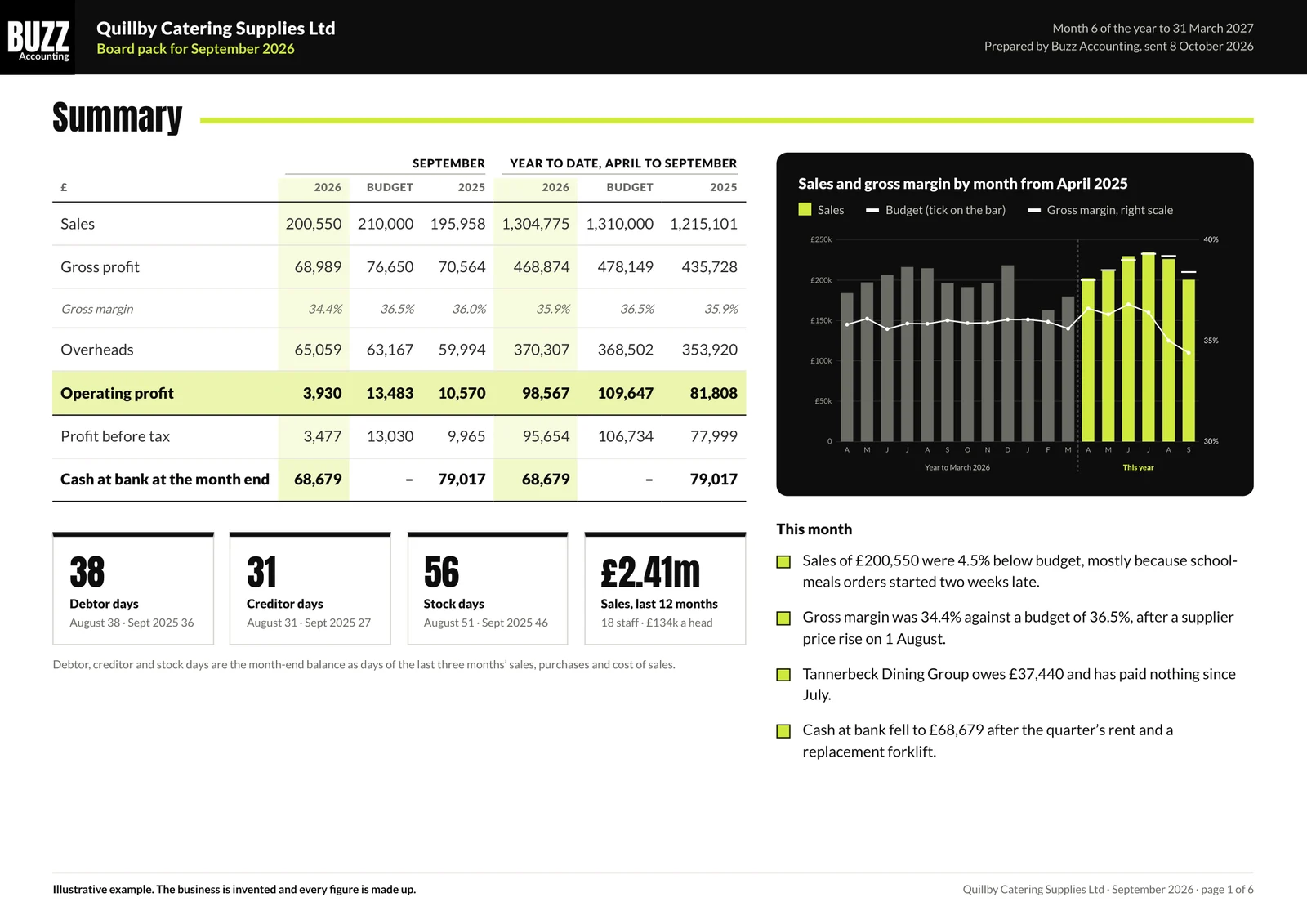
Sample monthly board pack
Six pages for one month at an invented catering wholesaler with 18 staff, prepared the way the finance team prepares one for a client.
- 1Summary
- 2Profit and loss
- 3Balance sheet
- 4Cash
- 5Customers and suppliers
- 6Commentary
More guides

Management accounts explained
The contents of a monthly management pack, and how to read it.

KPIs to check every month in a small business
The KPIs an owner-managed business checks each month, how to set targets, leading and lagging measures, and a worked monthly KPI sheet.
Sample board pack
A six-page monthly board pack to download.

Gross margin explained
What gross margin is, how it differs from mark-up, how to calculate it, what moves it and why to check it monthly, with a worked example of the confusion.

Working capital explained
What working capital is, how to calculate it from a balance sheet, the working capital cycle in days, why growth uses cash, and a worked example.

Budget against actual variances explained
How to compare each month's results with the budget, tell favourable from adverse variances, split price from volume and decide which ones to act on.

Management accounts for a construction company
Management accounts for builders and contractors: work in progress, retentions, CIS deductions, the VAT reverse charge and margin by contract.
Setting up monthly management reports in Xero
How to set up monthly management reports in Xero: the ledger work first, then the Management Report pack, budget variance, tracking and commentary.

The 13-week cash flow forecast
How to build a 13-week cash flow forecast, update it every Monday and act on it, with payroll, PAYE, VAT and Corporation Tax in the right weeks.

Month-end close for a small business
How to close the books by working day 10: the reconciliations, accruals and prepayments, the review, and what the management accounts should show.

Debtor control and getting paid faster
Payment terms, invoicing, a chase sequence by day, debtor days, and statutory late payment interest and compensation at the rates on GOV.UK today.

The monthly KPI pack and board pack
The 8 to 12 numbers an owner-managed business should see every month, how to read them, and what a monthly board pack contains, with a worked example.

13-week cash flow forecast template
A free Excel template for the next 13 weeks of receipts, payments and bank balance.

Cash flow forecasting
How to build a 12-month forecast and keep it up to date.
How to read a cash flow forecast
What each line means and where a tight month shows up.

Why a profitable business runs out of cash
Profit is counted when you invoice and cash moves when you are paid. Where the difference goes, how much cash you need, and ways to release it.

How to reduce debtor days
How to work out debtor days, the steps that bring them down, from payment terms to a weekly chasing routine, and the cash a lower figure releases.

Charging interest on late payments
Statutory interest at 8% above base rate, the fixed sums of £40, £70 and £100, when the late payment law applies, how to claim and how to word your terms.

Setting aside money for VAT, PAYE and Corporation Tax
When VAT, PAYE and Corporation Tax are due, how to work out what to move to a tax account each month, and a worked example for a limited company.

CIS deductions and a builder's cash flow
How CIS deductions of 20%, 30% or nothing reduce what a subcontractor banks on each invoice, HMRC deadlines, and gross payment status.

Outsourced credit control and how it works
What an outsourced credit controller does each week, how it runs in your Xero, what it costs against employing one, and the cash it releases.

Cash flow forecasting in Xero
What Xero's short-term cash flow projection shows, what it leaves out, and how to keep a 13-week or 12-month forecast alongside Xero.

How to price for profit
What a price change does to profit, worked through.

Turnover up, profit down
Why sales can rise while profit falls, and where to look.

How to set an annual budget for your business
Six steps to next year's budget, a month-by-month worked example, seasonality, wage rises from April 2026, and reforecasting during the year.
Break-even point explained
How to work out break-even in sales and in units from fixed costs, variable costs and contribution margin, with a worked example and the margin of safety.

What a price rise does to profit
How a small price rise flows straight to profit, how many customers you could lose and still be better off, and how much more you must sell after a discount.
Job costing for small businesses
How to cost each job with materials, labour at a loaded hourly rate, subcontractors and overheads, compare quoted with actual, and value work in progress.

What does a part-time finance director do?
What a part-time or fractional finance director does, the first three months, how it differs from a financial controller, and what one costs.

Finance manager or financial controller?
What a finance manager does, what a financial controller adds, the month-end close, deadlines, how to choose, and what each costs to employ or outsource.
Month-end close checklist
The steps to close the books within five working days: bank, ledgers, accruals, prepayments, payroll, VAT, stock, fixed assets and a final review.

In-house or outsourced bookkeeper?
What employing a bookkeeper costs once National Insurance, pension and holiday cover are added, what an outsourced service covers, and how to switch.

How to run a monthly board meeting
Who attends a board meeting in an owner-managed company, what goes in the board pack, a standard agenda, the decisions and actions log, and the minutes.

Replacing a bookkeeper who has left
Keeping payroll, VAT and the books running when your bookkeeper goes.
The cost of employing a financial controller
What a finance manager, financial controller and finance director cost to employ in 2026 to 2027, with National Insurance and pension, against Buzz fees.
How much a part-time finance director costs
A part-time finance director from Buzz costs £2,000 + VAT a month with the finance team included, against £128,508.40 a year to employ one.
Fractional CFO, part-time FD or interim FD
What a fractional CFO, a part-time finance director, an outsourced CFO and an interim FD each are, and how to choose one for your business.

What a bank wants to see in a business plan
What a lender reads in a business plan: the amount and purpose, ability to repay, forecasts, assumptions, security, guarantees and the people running it.
Talk to us
Tell us about the business and what is taking up your week, or book 30 minutes with Peter. He will come back within 48 hours with the level that fits and a fixed monthly fee.
Book a callOr call
07476 989568Accreditations and partners