A contractor deducts 20% of a registered subcontractor's labour before paying an invoice, 30% if the subcontractor is not registered for the Construction Industry Scheme, or nothing at all with gross payment status. The deduction leaves the subcontractor's bank account straight away, so a cash flow forecast built on the gross invoice total shows more cash than lands in the bank.
CIS deduction rates
HMRC sets three rates: 20% for a subcontractor verified as registered, 30% for one who has not registered or cannot be verified, and 0% for a subcontractor who holds gross payment status (GOV.UK). A contractor verifies every subcontractor with HMRC before paying them for the first time, and HMRC returns the rate to use.
To verify a subcontractor, a contractor gives HMRC the subcontractor's Unique Taxpayer Reference and, for a sole trader, their National Insurance number, or a company's registration number and company UTR for a limited company (GOV.UK). The check is done through the free HMRC CIS online service, or commercial CIS software once a contractor is verifying more than 50 subcontractors a year.
A subcontractor who has not been verified on a particular job is paid at 30% until the check is done, so a new subcontractor relationship can lose a third of the first invoice to deductions before the paperwork catches up.
What the deduction applies to
The deduction is worked out on the invoice after taking off VAT, materials the subcontractor paid for directly, and a short list of other costs: consumable stores, fuel other than for travelling, plant hire, and the cost of manufacturing or prefabricating materials (GOV.UK). Only the labour element is deducted from, so a subcontractor who itemises materials on the invoice and can show a receipt keeps the materials cost out of the deduction.
A contractor can ask for evidence such as a receipt; without one, GOV.UK says the contractor estimates the cost of the materials themselves, which can come in lower than the real figure. An invoice that lumps materials and labour into one figure loses that protection, so a subcontractor billing for both together should itemise them.
Paying and filing with HMRC
A contractor pays the deductions taken in a tax month to HMRC by the 22nd of the following month if paying electronically, or the 19th if paying by post (GOV.UK). A tax month runs from the 6th to the 5th. The monthly CIS return showing every subcontractor paid and the deduction taken is also due by the 19th of the month after the tax month ends.
A return one day late carries a £100 penalty, rising to £200 at two months, £300 or 5% of the CIS deductions on the return (whichever is higher) at six months and again at 12 months, and up to £3,000 or 100% of the deductions beyond 12 months (GOV.UK). The penalties are the contractor's to pay, so a contractor running several subcontractors needs the return filed on a fixed date each month regardless of which invoices are still being queried.
A contractor must also give the subcontractor a payment and deduction statement within 14 days of the end of each tax month, showing the gross amount, the cost of materials taken off, and the deduction (GOV.UK). The subcontractor needs this statement to show their accountant when the deduction is set against their own tax bill at the year end.
Gross payment status
A subcontractor can apply to be paid without any deduction. HMRC tests the business, its compliance record and its turnover: net construction turnover of at least £30,000 in the 12 months before applying for each partner or director, or £200,000 for the whole business whatever its size (GOV.UK, Construction Industry Scheme Reform manual, CISR43180). A sole trader needs the £30,000 figure on their own; a partnership of three partners needs £90,000 between them unless it relies on the £200,000 alternative test.
The compliance test looks at whether the business has sent its tax returns and paid what it owes on time over the past 12 months, as well as the turnover test. Gross payment status is reviewed regularly once granted, and HMRC can withdraw it if a return or a payment to HMRC is late after that.
A worked example
One subcontractor invoice, registered and verified
| Labour on the invoice | £18,000 |
| Materials, itemised and receipted | £6,000 |
| CIS deduction at 20% of labour | −£3,600 |
| VAT at 20% on the full invoice | £4,800 |
| Paid into the bank | £25,200 |
An example on invented round numbers for a registered subcontractor paid monthly.
The subcontractor banks £25,200 against an invoice before VAT of £24,000, because VAT is charged on the full amount and sits outside the CIS deduction. The £3,600 taken off is recorded on the payment and deduction statement the contractor gives the subcontractor each month. The same labour invoice from a subcontractor who has not been verified, deducted at 30% instead of 20%, would lose £5,400 instead of £3,600, a further £1,800 held back on this one invoice alone until the verification is done and the rate corrected.
The amount deducted is set against the subcontractor's own Income Tax or Corporation Tax and National Insurance bill when they file their tax return. A subcontractor whose deductions for the year add up to more than they owe HMRC is due a refund once the return is submitted and processed.
Putting CIS in a cash flow forecast
A cash flow forecast for a subcontractor should enter each invoice at the amount that lands in the bank after the CIS deduction. A forecast built on invoice totals overstates the cash available each month and can hide a shortfall until the real bank balance shows it.
The gap matters most for a subcontractor growing fast, because the deduction leaves on every invoice while materials and wages are often paid before the customer's invoice is even raised. A forecast that lines up the net cash in against the labour, materials and subcontractor costs going out each month shows the point in the year when the account is tightest.
A second deduction many builders meet is a retention held back by the main contractor until practical completion or the end of a defects period, under the terms agreed in the contract. Retentions and CIS deductions both cut the cash a subcontractor banks against an invoice, and a forecast needs to show when each is released as well as when it is taken off. A monthly cash flow forecast built around CIS and retentions is part of the finance director service for construction businesses, and the guide on why a profitable business runs out of cash covers the wider gap between profit and the cash in the bank.
This week, check which subcontractors on the books are still being paid at 30% because they have not been verified with HMRC, and submit the verification. Moving a subcontractor from 30% to 20% releases an extra 10% of their labour cost into the bank from the next payment.
Sources: GOV.UK, What you must do as a CIS contractor (verify subcontractors, make deductions and pay subcontractors, pay deductions to HMRC, file your monthly returns), and HMRC's Construction Industry Scheme Reform manual, CISR43180, on the turnover test for gross payment status.
Questions
What CIS deduction rate applies to an unregistered subcontractor?
An unregistered subcontractor is paid at 30%, against 20% for a verified registered subcontractor and nothing at all for one with gross payment status (GOV.UK). The rate is set by HMRC when the contractor verifies the subcontractor before the first payment, and the contractor uses the rate HMRC returns. A subcontractor who registers for CIS but has not yet been verified on a particular job is still paid at 30% until the check is done, so registering alone does not bring the rate down by itself. The deduction is taken from the labour element of the invoice, after materials the subcontractor paid for directly and a short list of other costs are taken out first. On a £10,000 labour invoice, the difference between 30% and 20% is £1,000 landing in the bank or not.
Does CIS apply to materials as well as labour?
CIS applies to the labour element of an invoice. Before working out the deduction, the contractor takes off VAT, materials the subcontractor paid for directly, consumable stores, fuel other than for travelling, plant hire, and the cost of manufacturing or prefabricating materials (GOV.UK). A contractor can ask for evidence such as a receipt for the materials; without one, GOV.UK says the contractor estimates the cost themselves, which can be lower than the real figure. A subcontractor who itemises materials separately on the invoice and keeps the receipts keeps that part of the bill out of the deduction. An invoice that bundles materials and labour into a single figure risks the whole amount, including the materials, being treated as labour when the deduction is worked out.
When must a contractor pay CIS deductions to HMRC?
A contractor pays the CIS deductions taken in a tax month to HMRC by the 22nd of the following month if paying electronically, or the 19th if paying by post (GOV.UK). A tax month runs from the 6th to the 5th, so deductions on payments made between 6 April and 5 May are due by 22 May if paid electronically. The monthly CIS return covering the same tax month, showing every subcontractor paid and the deduction taken, is also due by the 19th of the following month. Filing late carries a fixed penalty from £100 for one day, rising with how late the return is and, from six months, to £300 or 5% of the deductions on the return, whichever is higher (GOV.UK).
How does a subcontractor qualify for gross payment status?
A subcontractor qualifies for gross payment status by passing HMRC's business test, compliance test and turnover test. The turnover test needs net construction turnover, income from construction work after taking off the cost of materials, of at least £30,000 in the 12 months before applying for each partner or director, or £200,000 for the whole business regardless of how many partners or directors it has (GOV.UK, Construction Industry Scheme Reform manual, CISR43180). A sole trader needs £30,000 on their own; a partnership of three partners needs £90,000 between them unless it relies on the £200,000 alternative test. HMRC reviews the status regularly and can withdraw it if a return or a payment is late, so staying current matters as much as qualifying in the first place.
What happens if a CIS subcontractor has paid more in deductions than they owe?
The CIS deducted from a subcontractor across the year is set against their own Income Tax or Corporation Tax and National Insurance bill when they file their tax return. A subcontractor whose deductions for the year add up to more than they owe HMRC is due a refund once the return is submitted and processed. Keeping every payment and deduction statement from each contractor during the year, and giving them to the accountant preparing the return, is what lets the full amount be claimed, and a missing statement can mean a deduction HMRC cannot match is left out. A subcontractor banking net amounts all year, after 20% or 30% has gone to HMRC each time, can be waiting on a sizeable sum until the return is filed and the refund paid.
How should a builder forecast cash flow around CIS deductions?
A cash flow forecast for a subcontractor should show each invoice at the net amount after the CIS deduction, the figure that reaches the bank. Materials and wages are often paid out before the customer's invoice is raised or paid, so the forecast needs the timing of both the cash going out and the net cash coming in from each job. A forecast built on gross invoice totals can show a bank balance the business will not have, and the shortfall only becomes visible once the real balance falls. The guide on why a profitable business runs out of cash covers the wider gap between profit and the cash in the bank, and the Buzz finance director service for construction businesses builds CIS and retentions into the forecast.
13-week cash flow forecast template
An Excel workbook with receipts and payments for 13 weeks, the closing balance and the low point worked out, and an example filled in with invented figures.
- 1How to use
- 2Forecast, blank
- 3Example, filled in
More guides

Cash flow forecasting
How to build a 12-month forecast and keep it up to date.

How to read a cash flow forecast
What each line means and where a tight month shows up.

Why a profitable business runs out of cash
Profit is counted when you invoice and cash moves when you are paid. Where the difference goes, how much cash you need, and ways to release it.

How to reduce debtor days
How to work out debtor days, the steps that bring them down, from payment terms to a weekly chasing routine, and the cash a lower figure releases.

Charging interest on late payments
Statutory interest at 8% above base rate, the fixed sums of £40, £70 and £100, when the late payment law applies, how to claim and how to word your terms.

Setting aside money for VAT, PAYE and Corporation Tax
When VAT, PAYE and Corporation Tax are due, how to work out what to move to a tax account each month, and a worked example for a limited company.

Outsourced credit control and how it works
What an outsourced credit controller does each week, how it runs in your Xero, what it costs against employing one, and the cash it releases.

Cash flow forecasting in Xero
What Xero's short-term cash flow projection shows, what it leaves out, and how to keep a 13-week or 12-month forecast alongside Xero.

The 13-week cash flow forecast
How to build a 13-week cash flow forecast, update it every Monday and act on it, with payroll, PAYE, VAT and Corporation Tax in the right weeks.

Month-end close for a small business
How to close the books by working day 10: the reconciliations, accruals and prepayments, the review, and what the management accounts should show.

Debtor control and getting paid faster
Payment terms, invoicing, a chase sequence by day, debtor days, and statutory late payment interest and compensation at the rates on GOV.UK today.

The monthly KPI pack and board pack
The 8 to 12 numbers an owner-managed business should see every month, how to read them, and what a monthly board pack contains, with a worked example.

13-week cash flow forecast template
A free Excel template for the next 13 weeks of receipts, payments and bank balance.
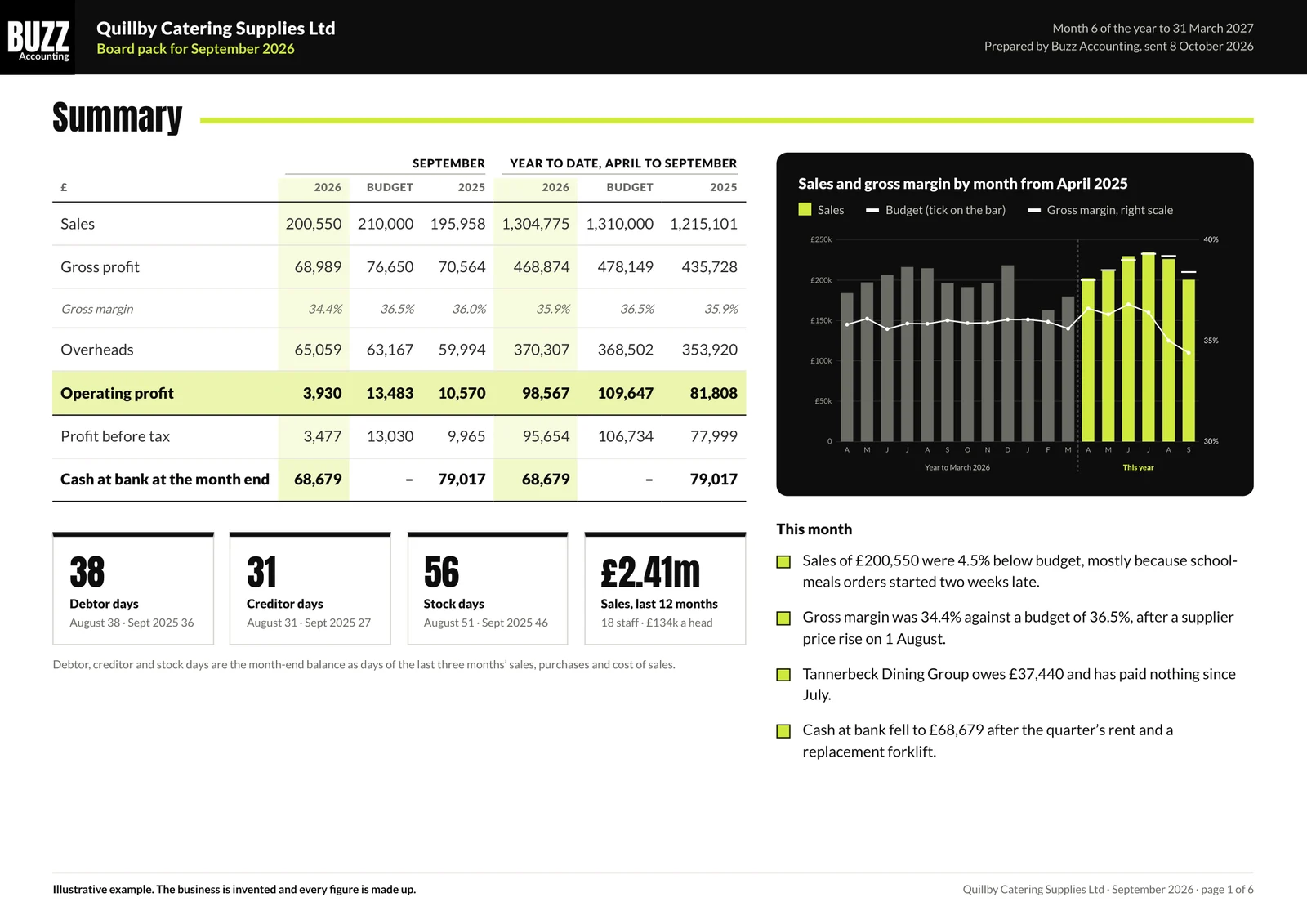
Sample board pack
A six-page monthly board pack to download.
Management accounts explained
The contents of a monthly management pack, and how to read it.

KPIs to check every month in a small business
The KPIs an owner-managed business checks each month, how to set targets, leading and lagging measures, and a worked monthly KPI sheet.
Sample board pack
A six-page monthly board pack to download.

Gross margin explained
What gross margin is, how it differs from mark-up, how to calculate it, what moves it and why to check it monthly, with a worked example of the confusion.

Working capital explained
What working capital is, how to calculate it from a balance sheet, the working capital cycle in days, why growth uses cash, and a worked example.

Budget against actual variances explained
How to compare each month's results with the budget, tell favourable from adverse variances, split price from volume and decide which ones to act on.

What management accounts cost and include
Management accounts from £375 a month quarterly or £499 monthly + VAT: what a monthly set contains, what the owner provides and when it should arrive.

Management accounts for a construction company
Management accounts for builders and contractors: work in progress, retentions, CIS deductions, the VAT reverse charge and margin by contract.
Setting up monthly management reports in Xero
How to set up monthly management reports in Xero: the ledger work first, then the Management Report pack, budget variance, tracking and commentary.

How to price for profit
What a price change does to profit, worked through.

Turnover up, profit down
Why sales can rise while profit falls, and where to look.

How to set an annual budget for your business
Six steps to next year's budget, a month-by-month worked example, seasonality, wage rises from April 2026, and reforecasting during the year.
Break-even point explained
How to work out break-even in sales and in units from fixed costs, variable costs and contribution margin, with a worked example and the margin of safety.

What a price rise does to profit
How a small price rise flows straight to profit, how many customers you could lose and still be better off, and how much more you must sell after a discount.
Job costing for small businesses
How to cost each job with materials, labour at a loaded hourly rate, subcontractors and overheads, compare quoted with actual, and value work in progress.

What does a part-time finance director do?
What a part-time or fractional finance director does, the first three months, how it differs from a financial controller, and what one costs.

Finance manager or financial controller?
What a finance manager does, what a financial controller adds, the month-end close, deadlines, how to choose, and what each costs to employ or outsource.
Month-end close checklist
The steps to close the books within five working days: bank, ledgers, accruals, prepayments, payroll, VAT, stock, fixed assets and a final review.

In-house or outsourced bookkeeper?
What employing a bookkeeper costs once National Insurance, pension and holiday cover are added, what an outsourced service covers, and how to switch.

How to run a monthly board meeting
Who attends a board meeting in an owner-managed company, what goes in the board pack, a standard agenda, the decisions and actions log, and the minutes.

Replacing a bookkeeper who has left
Keeping payroll, VAT and the books running when your bookkeeper goes.
The cost of employing a financial controller
What a finance manager, financial controller and finance director cost to employ in 2026 to 2027, with National Insurance and pension, against Buzz fees.
How much a part-time finance director costs
A part-time finance director from Buzz costs £2,000 + VAT a month with the finance team included, against £128,508.40 a year to employ one.
Fractional CFO, part-time FD or interim FD
What a fractional CFO, a part-time finance director, an outsourced CFO and an interim FD each are, and how to choose one for your business.

What a bank wants to see in a business plan
What a lender reads in a business plan: the amount and purpose, ability to repay, forecasts, assumptions, security, guarantees and the people running it.
Talk to us
Tell us about the business and what is taking up your week, or book 30 minutes with Peter. He will come back within 48 hours with the level that fits and a fixed monthly fee.
Book a callOr call
07476 989568Accreditations and partners